


Learn more about various concentrations, explore the Curriculum adjust your Course Schedule to fit your time, know the required Tuition Fees, and understand the expected learning outcomes All the information you need to start your academic journey is here.

Curriculum
The curriculum of the Bachelor’s Program in Information Technology at USU is designed using an Outcome-Based Education (OBE) approach that is systematically integrated to develop student competencies over eight semesters. A visual representation of this competency development pathway can be studied through the OBE Curriculum Map Diagram available at the following link.
The education system of the Bachelor’s Program in Information Technology at USU applies a holistic approach that balances mastery of cognitive aspects with the structured development of soft skills. Students are guided to excel in communication, teamwork, scientific writing, and innovation while upholding professional ethics. These qualities are internalized through project-based learning methods, collaborative assignments, and industrial internship programs to produce globally competitive graduates.
Regarding the curriculum mechanism, students follow a fixed course package in the early semesters, while flexibility in taking Semester Credit Units (SKS) is gradually implemented in the following semesters based on their Semester Grade Point Average (GPA). Students who demonstrate strong academic performance are given the opportunity to accelerate their study period by taking a larger credit load, under consultation and intensive supervision from academic advisors.

Course Schedule
Concentration
To strengthen student competencies, the Bachelor’s Program in Information Technology at USU provides elective courses structured within various areas of specialization. This curriculum is designed as a platform for students to explore their potential and align their technical expertise with their career plans.
Through these strategic specialization options, students are expected to master specific areas of expertise that are relevant to technological advancements and current industry demands.
There are three main specialization tracks available: Intelligent Systems and Data Science, Information Technology Infrastructure, and Visual Computing and Interactive Systems.
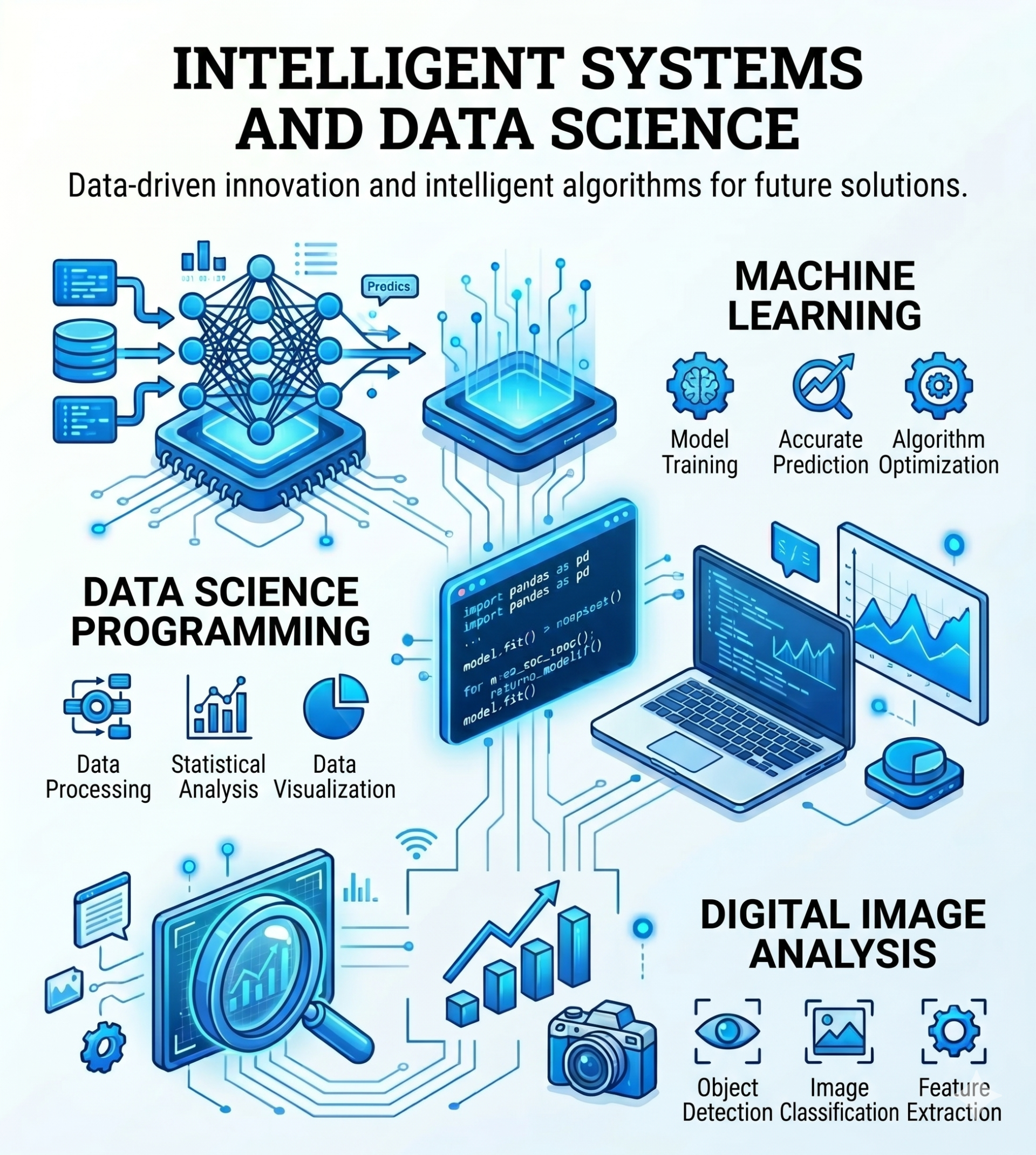
Intelligent Systems and Data Science
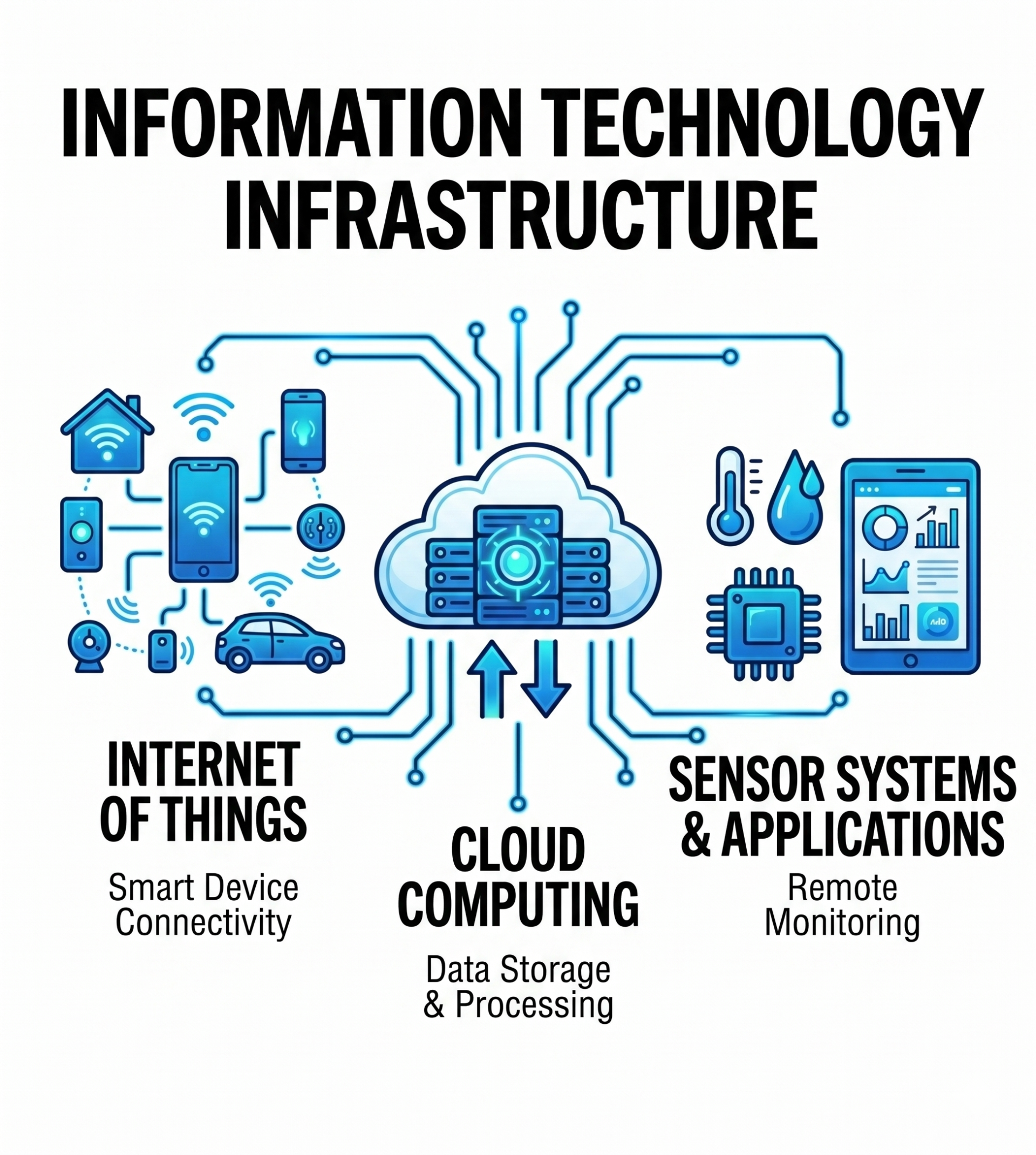
Information Technology Infrastructure
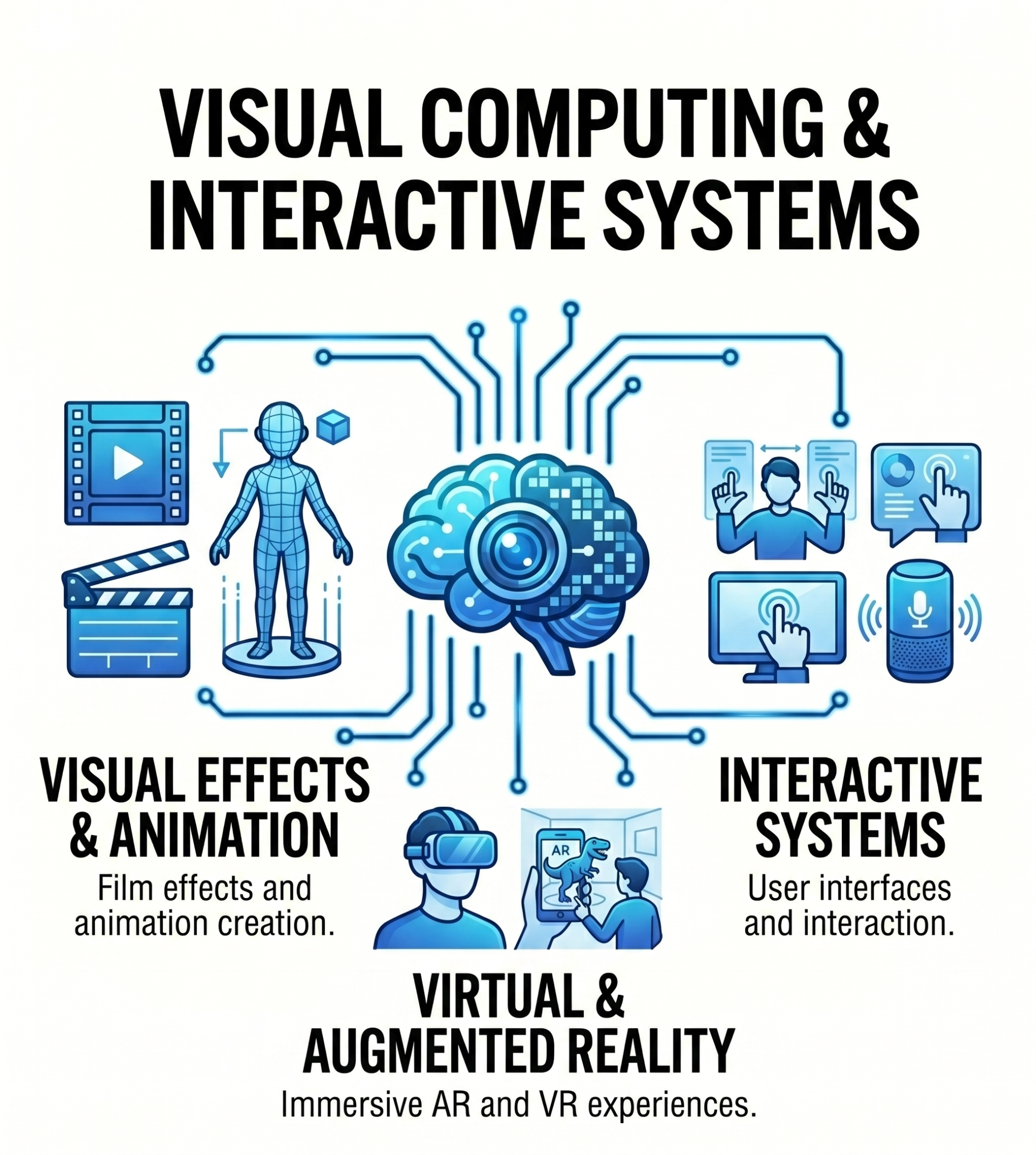
Visual Computing and Interactive Systems
Education and Research Laboratories
Laboratory courses play an important role in the curriculum structure to directly apply theories in a practical domain. Through a series of practicums, students not only hone their technical skills but also their analytical acumen in implementing technological solutions, which ultimately strengthens their academic readiness and professionalism in the Information Technology sector.
Semester 1
- TIF1104 Basic Programming Practicum
- TIF1106 Web Programming Practicum
Semester 2
- TIF1202 Object-Oriented Programming Practicum
- TIF1204 Advanced Web Programming Practicum
- TIF1206 Database System Practicum
- TIF1208 Data Structure and Algorithm Practicum
Semester 3
- TIF2103 Data Communication and Computer Network Practicum
- TIF2105 Database System Management Practicum
- TIF2107 Advanced Object-Oriented Programming Practicum
- TIF2109 Semantic Web Practicum
Semester 4
- TIF2205 Human-Computer Interaction Practicum
- TIF2207 Artificial Intelligence Practicum
- TIF2209 Server and Network Security Practicum
Semester 5
- TIF3102 Network Administration and Design Practicum
- TIF3104 Interaction Design Practicum
- TIF3107 Mobile Programming Practicum
- TIF3109 Visual Effects and Animation Practicum
- TIF3111 Machine Learning Practicum
- TIF3113 Internet of Things Practicum
Semester 6
- TIF3206 Integrative Programming Practicum
- TIF3208 Network Routing Practicum
- TIF3210 Interactive System Practicum
- TIF3212 Data Science Programming Practicum
- TIF3214 Cloud Computing Practicum
Semester 7
- TIF4109 Virtual and Augmented Reality Practicum
- TIF4111 Digital Image Processing and Analysis Practicum
- TIF4113 Sensor System and Application Practicum
Study Duration
The educational structure of the Bachelor’s Program in Information Technology at USU is designed to be completed within a study period of 8 semesters or 4 years. During this period, students are required to complete the entire learning sequence, which includes a total academic workload of 146 Semester Credit Units (SKS).
The academic degree Bachelor of Computer Science (S.Kom.) will be awarded to students who have successfully completed all courses required in the curriculum. In addition to meeting the minimum requirement of 146 credits, students are also required to complete an internship/work placement and a final project/thesis as graduation requirements.
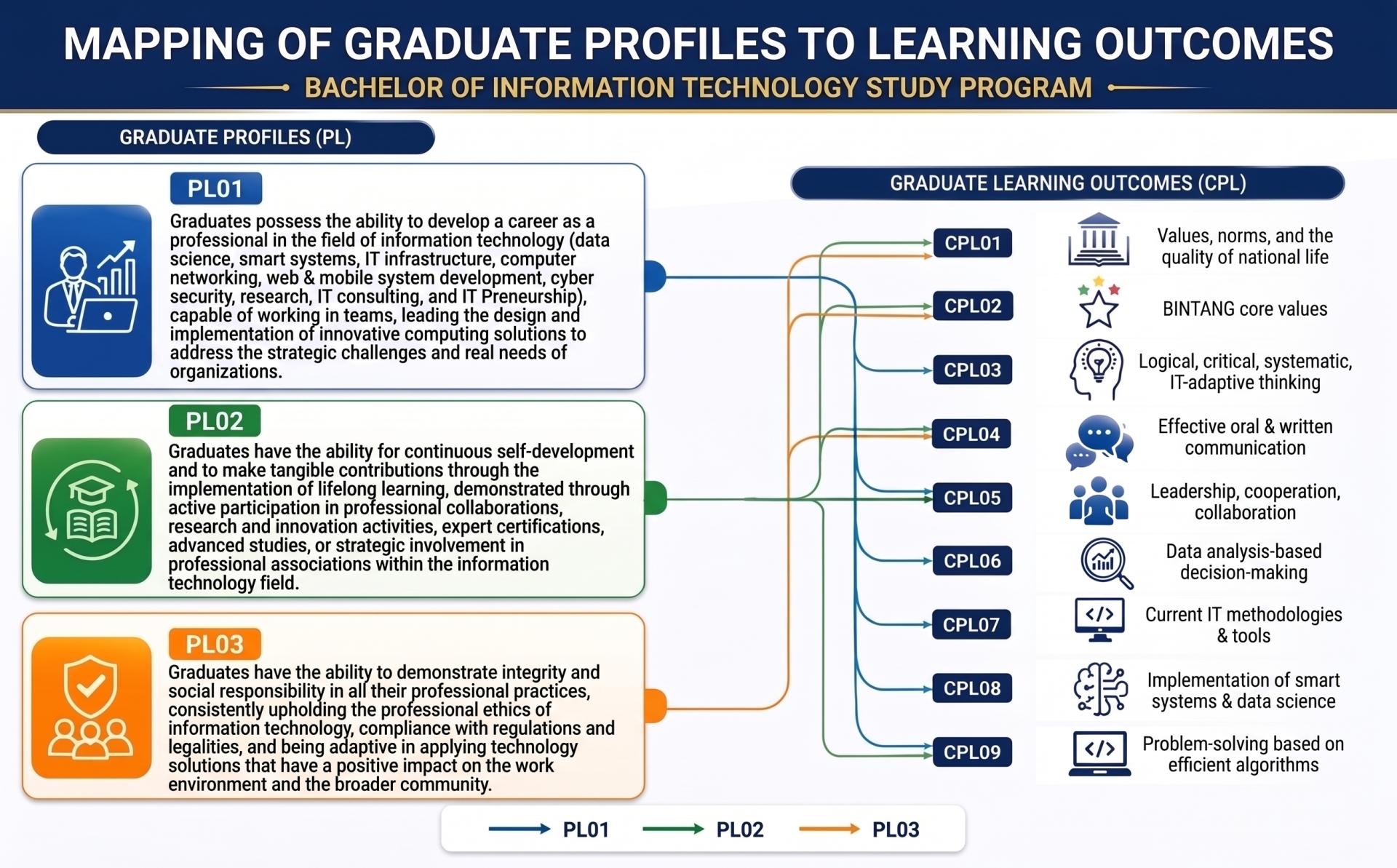
Graduate Profile
The Bachelor’s Program in Information Technology has developed its Graduate Profile (PL) based on guidelines and recommendations from the Association of Higher Education in Informatics and Computing (APTIKOM), international associations in the fields of computer science and information technology (Association for Computing Machinery (ACM), Institute of Electrical and Electronics Engineers (IEEE)), international accreditation bodies such as ABET (Accreditation Board for Engineering and Technology) and the Indonesian Accreditation Board for Engineering Education (IABEE), as well as references from leading global universities.
In determining the graduate profile, the Bachelor’s Program in Information Technology conducted interviews, discussions, and brainstorming sessions with faculty members, the alumni association, stakeholders, and industry partners as users of IT graduates. As a result, the Graduate Profile of the Bachelor’s Program in Information Technology was formulated into statements that describe the graduate profile as presented below:
PL-01
Ability to apply theoretical and empirical concepts to systematically and organizedly solve problems in the field of information technology in order to produce computing solutions that meet individual or organizational needs.
PL-02
Ability to develop oneself through lifelong learning to create sustainable positive impact in society in an ethical, responsible, professional, and lawful manner.
PL-03
Ability to build networks, collaborate in teams, communicate effectively, and adapt to other disciplines related to information technology.
PL-04
Ability to design and develop computer-based systems, including intelligent systems and data science solutions in the field of Information Technology to produce adaptive and innovative solutions for organizations.
Career Prospects for Graduates
Graduates of the Bachelor’s Program in Information Technology at USU have broad career opportunities across various sectors of industry, research, and technology development, including:
- Web Administrator
- System Analyst
- Database Administrator
- Data Engineer
- Data Scientist
- AI Engineer
- Network Desainer
- Network Engineer
- Network Administrator
- IT Enterpreneur
- IT Support
- Researcher
- UI/UX Designer
Learning Outcomes
Information Technology graduates are able to adapt to innovative Information Technology developments and make decisions on issues in the Information Technology field by identifying and analyzing computational requirements based on the results of a comprehensive analysis of information and data. Using current methodologies, techniques, expertise, tools, and techniques, identifying, analyzing, designing, implementing, and managing problems related to the application of Information Technology. This is done by integrating knowledge related to information technology and computer principles, using effective and efficient algorithms or methods. Maintaining BINTANG values and standards while improving the quality of life of the nation and state.
| Learning Outcomes | |
| 1 | Capable of maintaining an attitude of upholding principles and norms in carrying out responsibilities to improve the nation's and state's quality of life |
| 2 | Capable of applying BINTANG values (Fearing God Almighty in the framework of diversity, Innovative with integrity, Tough and Wise) |
| 3 | Capable of using logical, analytical, and systematic thinking to fulfill the demands of individuals or organizations and adapting to the development of innovative and fast-moving information technology. |
| 4 | Capable of communicating effectively and responsibly to professionals and the general public, both orally and in writing, in transmitting or presenting ideas and well-organized research results. |
| 5 | Capable of applying the spirit of responsible leadership, teamwork, entrepreneurship, and independence and collaborating in multidisciplinary and multi-cultural work groups. |
| 6 | Capable of making appropriate decisions in the framework of problem-solving in their field of competence based on the outcomes of information and data analysis and effective communication procedures |
| 7 | Capable of identifying, analyzing, designing, implementing, and managing the application of information technology using the most recent approaches, techniques, expertise, and tools. |
| 8 | Capable of implementing intelligent systems and data science in a specific platform environment to resolve real-world problems using information technology aspects |
| 9 | Capable of solving problems by combining qualified knowledge of the functioning principles of information technology and computers with effective and efficient algorithms or methods |
Tuition Fee